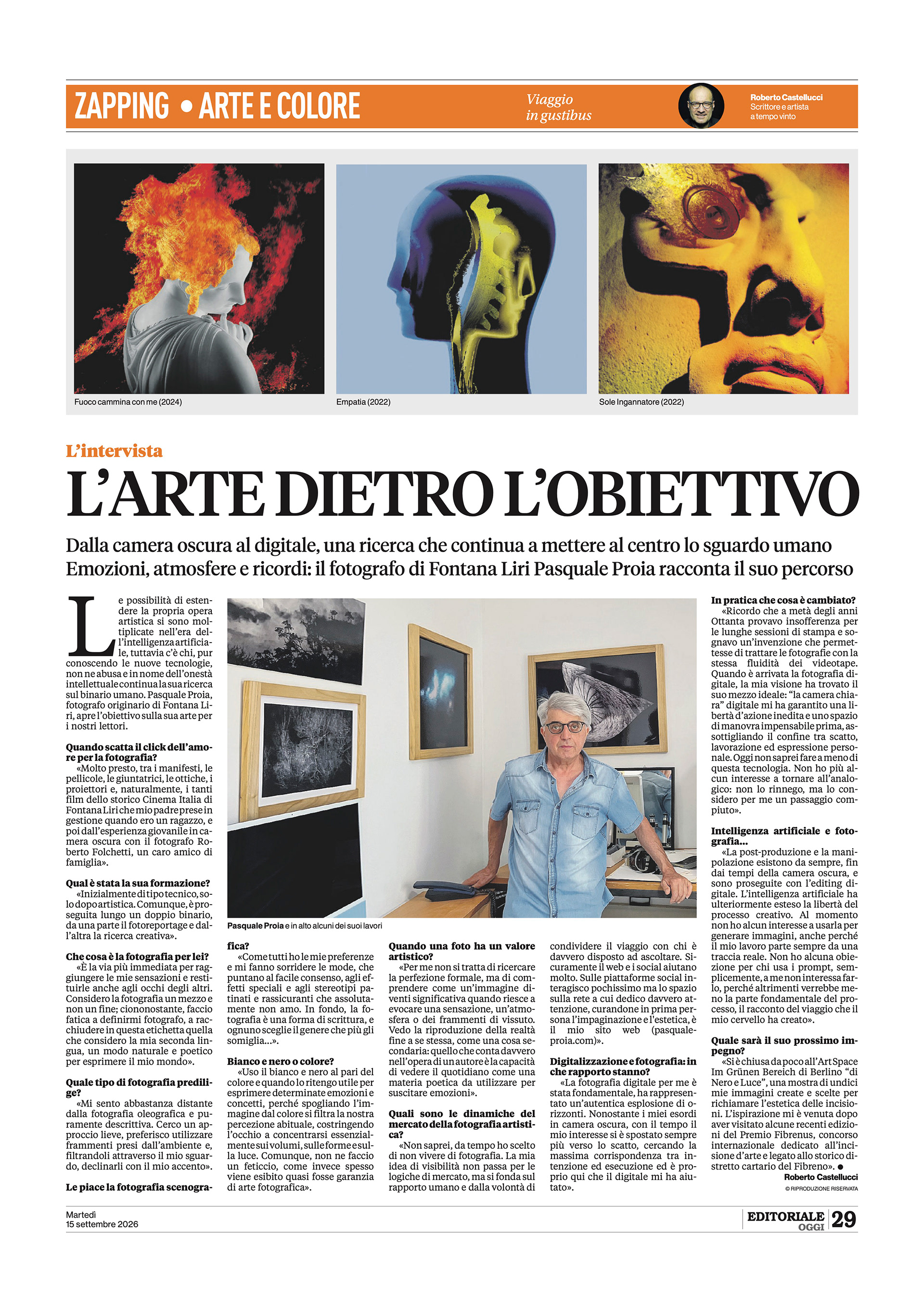
When did the spark of love for photography first strike Pasquale Proia?
“Rather than a spark, one might speak of an electric arc: the one produced by the carbon rods of the old cinema projectors. I was a boy when my father took over the management of the historic Cinema Italia in Fontana Liri. Inevitably, I came into contact with posters, film reels, splicing machines, lenses, projectors and, of course, films. The projection booth thus became the place where my fascination with images began, and films their sublimation.
Almost at the same time, my first real contact with photography came through a family friend, Roberto Folchetti, a third-generation photographer from a family of photographers in Arpino that had been active in our area since the beginning of the twentieth century. He was my first teacher: I worked with him from the age of thirteen, starting in the darkroom and then moving on to taking photographs. From him I learned how to work among people, during ceremonies, which represented the heart of the Folchetti family’s work.
I still clearly remember my first times under the enlarger: my teacher had me stand on a stool and, after showing me how to focus, entrusted me with the following steps. Those were important years of learning the craft, but what stays with me most, and what I miss most about him, is his naturalness, the subtle irony in his smile, I would say almost an innate grace in being a photographer without any sense of self-importance.”
Almost at the same time, my first real contact with photography came through a family friend, Roberto Folchetti, a third-generation photographer from a family of photographers in Arpino that had been active in our area since the beginning of the twentieth century. He was my first teacher: I worked with him from the age of thirteen, starting in the darkroom and then moving on to taking photographs. From him I learned how to work among people, during ceremonies, which represented the heart of the Folchetti family’s work.
I still clearly remember my first times under the enlarger: my teacher had me stand on a stool and, after showing me how to focus, entrusted me with the following steps. Those were important years of learning the craft, but what stays with me most, and what I miss most about him, is his naturalness, the subtle irony in his smile, I would say almost an innate grace in being a photographer without any sense of self-importance.”
What was your educational background?
"I received a technical education, far removed from the world of art, and it took me some time to understand that I could have taken a different path. This, however, did not prevent me from pursuing my passion continuously. After completing my technical studies, I attended a photojournalism course in Rome at the Regional Centre for Vocational Training.
Photojournalism itself interested me very little, but the course provided the necessary break: meeting new realities and fellow photographers meant stepping beyond the boundaries of the province and, above all, beyond the confines of what I had already seen. From there, I began to approach the world of art and its history with growing curiosity.
During the course, under the guidance of teachers including director of photography Erico Menczer, I learned to ‘read’ light before even measuring it, consolidating a method based on the use of natural light and an awareness of the frame.
At the same time, my research moved along paths connected with the avant-gardes of the twentieth century: from Man Ray’s Rayographs to László Moholy-Nagy’s ‘New Vision’, and finally to Otto Steinert’s ‘Subjektive Fotografie’. During that period, Surrealism was an inner compass for me: it taught me the importance of listening inwardly, giving me the courage to explore that deeper dimension which continues to guide my evolution today.
Another fundamental encounter was with the work of Andreas Feininger, from whom I drew a rigorous approach to framing and compositional discipline, but also the ability to overturn that very formality in order to allow the deeper meaning of the image to emerge.
These studies eventually came together in my final course thesis, Photography from Surrealism to Otto Steinert (1987), marking one of the most fruitful periods of my journey.
This inclination to move across different yet complementary dimensions has always been a constant in my life: a precious resource, although not without its difficulties and sacrifices.
Finally, my friendship and dialogue with the artist and professor Vincenzo Bianchi played a central role. I am grateful to him for always encouraging my research. His support was decisive, particularly at two important stages: my solo exhibition in Senigallia in 2016, promoted at the Museum of Photography, then directed by Professor Carlo Emanuele Bugatti, and the exhibition Omaggio ad Umberto Mastroianni in Sora in 2017, which he curated. These were two crucial moments that marked my return to exhibiting after a long and troubled period of reflection.”
Photojournalism itself interested me very little, but the course provided the necessary break: meeting new realities and fellow photographers meant stepping beyond the boundaries of the province and, above all, beyond the confines of what I had already seen. From there, I began to approach the world of art and its history with growing curiosity.
During the course, under the guidance of teachers including director of photography Erico Menczer, I learned to ‘read’ light before even measuring it, consolidating a method based on the use of natural light and an awareness of the frame.
At the same time, my research moved along paths connected with the avant-gardes of the twentieth century: from Man Ray’s Rayographs to László Moholy-Nagy’s ‘New Vision’, and finally to Otto Steinert’s ‘Subjektive Fotografie’. During that period, Surrealism was an inner compass for me: it taught me the importance of listening inwardly, giving me the courage to explore that deeper dimension which continues to guide my evolution today.
Another fundamental encounter was with the work of Andreas Feininger, from whom I drew a rigorous approach to framing and compositional discipline, but also the ability to overturn that very formality in order to allow the deeper meaning of the image to emerge.
These studies eventually came together in my final course thesis, Photography from Surrealism to Otto Steinert (1987), marking one of the most fruitful periods of my journey.
This inclination to move across different yet complementary dimensions has always been a constant in my life: a precious resource, although not without its difficulties and sacrifices.
Finally, my friendship and dialogue with the artist and professor Vincenzo Bianchi played a central role. I am grateful to him for always encouraging my research. His support was decisive, particularly at two important stages: my solo exhibition in Senigallia in 2016, promoted at the Museum of Photography, then directed by Professor Carlo Emanuele Bugatti, and the exhibition Omaggio ad Umberto Mastroianni in Sora in 2017, which he curated. These were two crucial moments that marked my return to exhibiting after a long and troubled period of reflection.”
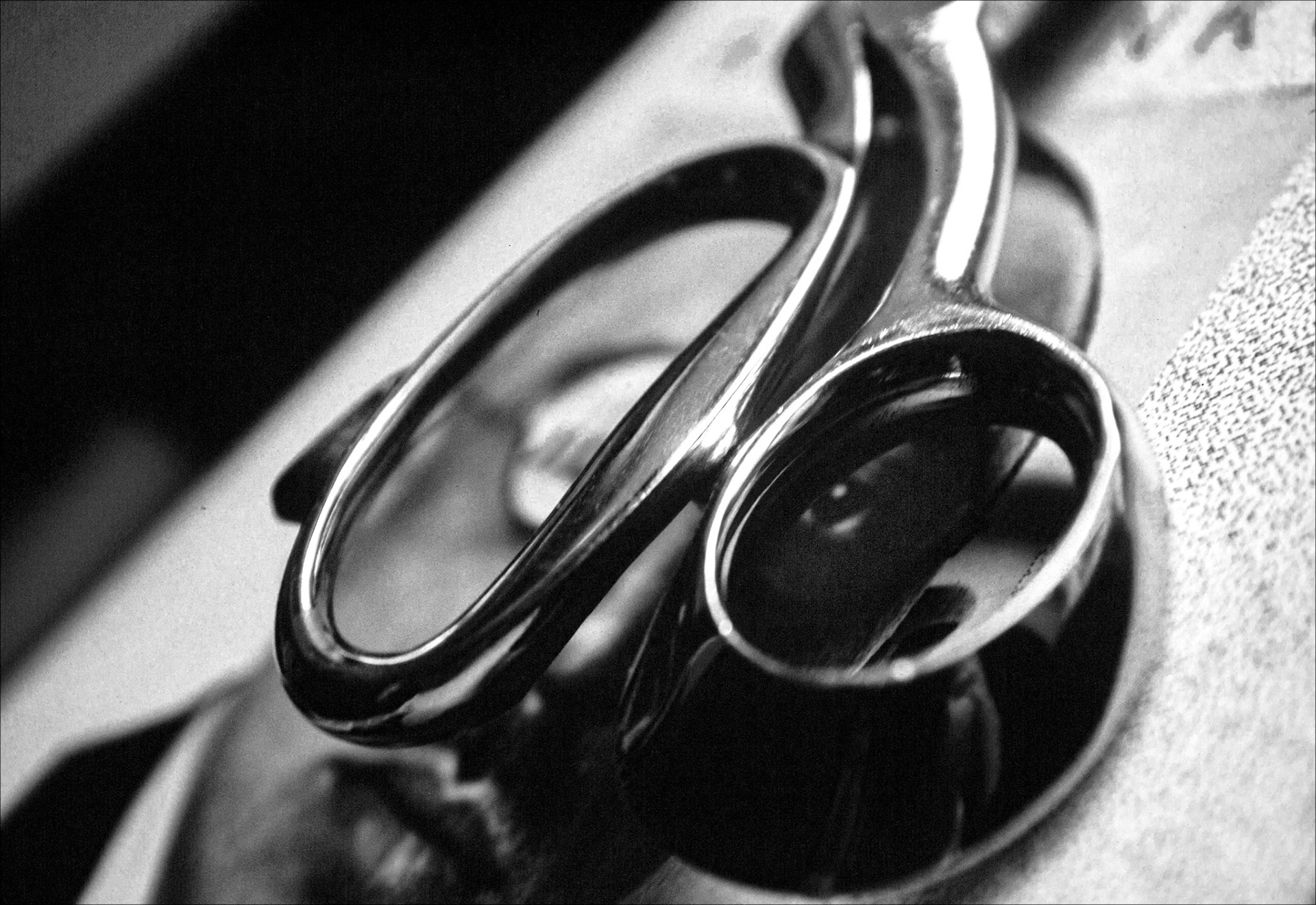
To Aleksandr Rodčenko |1993
What is photography to you?
“I am in love with images, and I am fascinated by creating them. For me, photography is the most immediate way, the one I have the greatest command of, to reach my own sensations and return them to the eyes of others. I consider photography a means, not an end; nevertheless, I find it difficult to define myself as a ‘photographer’, to confine within this theoretical definition what I consider my second language, a natural and poetic way of expressing my world.
I feel quite distant from photography as a mirror of reality. I seek a light approach and prefer to use fragments taken from my surroundings and, starting from my own points of observation, reinterpret them through my language, with my inflection and my accent.
I love the richness of different languages, and I enjoy looking at the work of others, even when it is very far from my own way of seeing, provided I find it sincere. I appreciate its honesty and spontaneity, free from reassuring formulas.
I am not a purist confined by the dogmas of art; simply, in my own research, I follow the path that feels most congenial to me. Like everyone, I have my preferences: I smile at trends, the pursuit of easy approval, special effects, glamour and stereotypes, simply.”
I feel quite distant from photography as a mirror of reality. I seek a light approach and prefer to use fragments taken from my surroundings and, starting from my own points of observation, reinterpret them through my language, with my inflection and my accent.
I love the richness of different languages, and I enjoy looking at the work of others, even when it is very far from my own way of seeing, provided I find it sincere. I appreciate its honesty and spontaneity, free from reassuring formulas.
I am not a purist confined by the dogmas of art; simply, in my own research, I follow the path that feels most congenial to me. Like everyone, I have my preferences: I smile at trends, the pursuit of easy approval, special effects, glamour and stereotypes, simply.”
What do you think of black and white? Does it enhance photography or not?
“Personally, I use black and white when I consider it useful for expressing and conveying certain emotions and concepts. I do not make a fetish of it, as it is often understood, presented and displayed, almost as though it were a sure guarantee of photographic art. On a compositional level, it is important and, for certain types of photography, sometimes irreplaceable, precisely because by stripping the image of colour, it filters our habitual perception, forcing the eye to concentrate essentially on volumes, forms and light.
Like many people of my generation, it was a necessary stage if one wanted to have full control over one’s work; I experimented with it extensively. Obviously, the aura surrounding black and white does not protect us from the superficial ways in which we can use it, both technically and expressively. If it is overused as a mere affectation, it risks becoming a banal special effect.”
“Personally, I use black and white when I consider it useful for expressing and conveying certain emotions and concepts. I do not make a fetish of it, as it is often understood, presented and displayed, almost as though it were a sure guarantee of photographic art. On a compositional level, it is important and, for certain types of photography, sometimes irreplaceable, precisely because by stripping the image of colour, it filters our habitual perception, forcing the eye to concentrate essentially on volumes, forms and light.
Like many people of my generation, it was a necessary stage if one wanted to have full control over one’s work; I experimented with it extensively. Obviously, the aura surrounding black and white does not protect us from the superficial ways in which we can use it, both technically and expressively. If it is overused as a mere affectation, it risks becoming a banal special effect.”
How can one recognize the artist’s emotion when looking at a photograph?
“Silence… and then a smile that opens the gaze to satisfaction: I think this is the emotion of an artist when recognizing something that touches them, when being in tune with someone through a work, when listening to the other person’s gaze speak directly to them.
Faced with an image that strikes us, this is precisely what happens: we recognize ourselves immediately, there is a clear perception of an intimate dialogue, in which we speak with our eyes.
Silences are not all the same.”
“Silence… and then a smile that opens the gaze to satisfaction: I think this is the emotion of an artist when recognizing something that touches them, when being in tune with someone through a work, when listening to the other person’s gaze speak directly to them.
Faced with an image that strikes us, this is precisely what happens: we recognize ourselves immediately, there is a clear perception of an intimate dialogue, in which we speak with our eyes.
Silences are not all the same.”

Solitudine | 2022
Is there a standard for artistically evaluating a photograph?
“I have no recipes; I can only express my point of view. It is not a matter of always seeking formal perfection, but of understanding how an image becomes meaningful when it manages to evoke a sensation, an atmosphere or fragments of lived experience. The reproduction of reality for its own sake, after all, can be considered secondary: for me, what really matters in an artist’s work is the ability to recognize the everyday as poetic material to be used for composition.
This is my standard of judgment: an image has value when it manages to convey an authentic emotion in which one can recognize oneself and, at the same time, is able to leave the viewer free to take another narrative direction, another path among the many universes we carry within us.”»
“I have no recipes; I can only express my point of view. It is not a matter of always seeking formal perfection, but of understanding how an image becomes meaningful when it manages to evoke a sensation, an atmosphere or fragments of lived experience. The reproduction of reality for its own sake, after all, can be considered secondary: for me, what really matters in an artist’s work is the ability to recognize the everyday as poetic material to be used for composition.
This is my standard of judgment: an image has value when it manages to convey an authentic emotion in which one can recognize oneself and, at the same time, is able to leave the viewer free to take another narrative direction, another path among the many universes we carry within us.”»
What are the means of gaining visibility for one’s photographic work in the art market?
“For some time now, I have chosen not to make a living from photography. Although I worked for many years as a photographer of ceremonies, I have always maintained a parallel path with another occupation. A choice also dictated by my character: I lack an entrepreneurial streak and the inclination to promote myself.
Certainly, the web and social media help a great deal, but I admit my distance from these dynamics. I interact very little on these platforms and use them almost exclusively to communicate my activities, keeping away from the chatter. The space on the web to which I devote real attention, taking care of its layout and aesthetics myself, is my website.
For this reason, my idea of visibility does not pass through market logic, but is based on human relationships. The best means remain simple gestures, born from an emotional impulse rather than calculation.
I think of my project Alcol, a tribute I dedicated to the singer-songwriter Claudio Lolli: as soon as it was ready, I had a catalogue printed and sent it directly to his family. From a spontaneous gesture of mine came a meeting in Bologna and the opportunity to consider an exhibition.
The most authentic visibility comes from here: from the desire to share the journey with those who are truly willing to listen.”
Certainly, the web and social media help a great deal, but I admit my distance from these dynamics. I interact very little on these platforms and use them almost exclusively to communicate my activities, keeping away from the chatter. The space on the web to which I devote real attention, taking care of its layout and aesthetics myself, is my website.
For this reason, my idea of visibility does not pass through market logic, but is based on human relationships. The best means remain simple gestures, born from an emotional impulse rather than calculation.
I think of my project Alcol, a tribute I dedicated to the singer-songwriter Claudio Lolli: as soon as it was ready, I had a catalogue printed and sent it directly to his family. From a spontaneous gesture of mine came a meeting in Bologna and the opportunity to consider an exhibition.
The most authentic visibility comes from here: from the desire to share the journey with those who are truly willing to listen.”
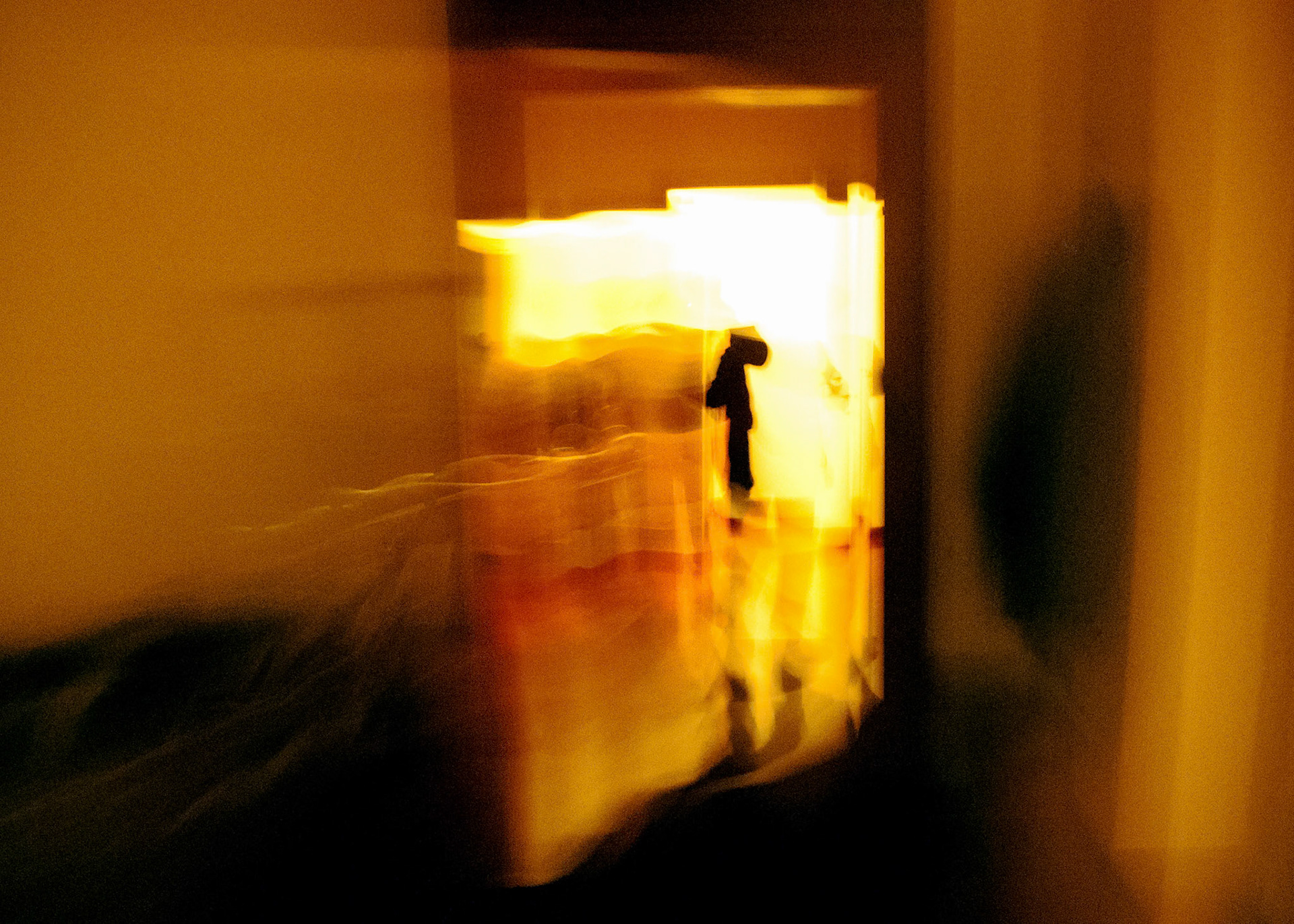
Sole Corto | 2016
How important has digitalization been for photography?
“For me, it has been fundamental; it represented a genuine explosion of horizons. Despite my almost magical beginnings in the darkroom, over time my interest had shifted increasingly towards taking the photograph, seeking the closest possible correspondence between intention and execution. Entering the darkroom had gradually become more and more arduous: I felt that the rigidity of the technical processes was holding back my creative urgency, with all due respect for the noble art of printers.
I remember that in the mid-1980s I was becoming impatient with the long printing sessions and dreamed of an invention that would make it possible to treat photographs with the same fluidity one had with videotapes.
When digital photography arrived, my vision found its ideal medium: the digital “camera chiara” opened up infinite possibilities for me, thinning that boundary between taking the photograph, processing it and personal expression.
Today I could no longer do without this technology. I have no interest whatsoever in returning to analogue: I do not deny it, but for me, I consider it a completed stage.”
“For me, it has been fundamental; it represented a genuine explosion of horizons. Despite my almost magical beginnings in the darkroom, over time my interest had shifted increasingly towards taking the photograph, seeking the closest possible correspondence between intention and execution. Entering the darkroom had gradually become more and more arduous: I felt that the rigidity of the technical processes was holding back my creative urgency, with all due respect for the noble art of printers.
I remember that in the mid-1980s I was becoming impatient with the long printing sessions and dreamed of an invention that would make it possible to treat photographs with the same fluidity one had with videotapes.
When digital photography arrived, my vision found its ideal medium: the digital “camera chiara” opened up infinite possibilities for me, thinning that boundary between taking the photograph, processing it and personal expression.
Today I could no longer do without this technology. I have no interest whatsoever in returning to analogue: I do not deny it, but for me, I consider it a completed stage.”
What impact does artificial intelligence have on photography, and how will it impact it technically?
“Starting from the premise that, for me, honesty always matters and in every aspect, when talking about photography we should avoid the false problems related to technical purism, which personally bore me. To those who cry scandal over manipulation or the ‘digital falsehood’, I would respond that, in the end, what matters are the images rather than knowing the technology or the system that generated them.
Post-production and manipulation have always existed, since the days of the darkroom, and digital technology has simply given us the freedom to expand the creative process.
In my case, and at this moment, I have no interest whatsoever in using artificial intelligence for image generation. I have no objection to those who use prompts or work in that way; it simply does not interest me. My work always starts from a concrete trace, from a visual and physical attraction, whether it is a damaged surface, a piece of wood or an old archival photograph, and develops through a personal mental and post-production process.
Of course, at times I may also use AI to rationalize certain technical processes or for some targeted retouching; but certainly not for poetic or aesthetic matters. For those, there is me, and I like to get my hands dirty and keep stirring until I obtain what I am looking for.
In the end, the real discriminating factor is not the tool itself, but the honesty with which one approaches one’s own work and vision: if I did not work in this way, for me, the fundamental part of the process would be lost, the restitution of the journey that my brain has worked through. This way of creating is an essential part of my satisfaction.”
“Starting from the premise that, for me, honesty always matters and in every aspect, when talking about photography we should avoid the false problems related to technical purism, which personally bore me. To those who cry scandal over manipulation or the ‘digital falsehood’, I would respond that, in the end, what matters are the images rather than knowing the technology or the system that generated them.
Post-production and manipulation have always existed, since the days of the darkroom, and digital technology has simply given us the freedom to expand the creative process.
In my case, and at this moment, I have no interest whatsoever in using artificial intelligence for image generation. I have no objection to those who use prompts or work in that way; it simply does not interest me. My work always starts from a concrete trace, from a visual and physical attraction, whether it is a damaged surface, a piece of wood or an old archival photograph, and develops through a personal mental and post-production process.
Of course, at times I may also use AI to rationalize certain technical processes or for some targeted retouching; but certainly not for poetic or aesthetic matters. For those, there is me, and I like to get my hands dirty and keep stirring until I obtain what I am looking for.
In the end, the real discriminating factor is not the tool itself, but the honesty with which one approaches one’s own work and vision: if I did not work in this way, for me, the fundamental part of the process would be lost, the restitution of the journey that my brain has worked through. This way of creating is an essential part of my satisfaction.”
What are the latest trends in photography?
“Honestly, I do not follow trends. For me, photography must respond to an inner urgency and to a personal visual research. My work travels along intimate paths, far from the logics of the moment, which I nevertheless respect.
I do not disdain speed and new technologies; on the contrary, I make use of them, but I need periods of decantation and moments of creative short-circuit. I prefer to look within myself, starting from the suggestions that my surroundings provide me with and then expressing them through my own language, rather than looking at what the market is doing.
For some time now, I have chosen to separate my financial livelihood from my artistic research precisely to allow myself this distance, even though it is not always easy and can sometimes be frustrating.”
I do not disdain speed and new technologies; on the contrary, I make use of them, but I need periods of decantation and moments of creative short-circuit. I prefer to look within myself, starting from the suggestions that my surroundings provide me with and then expressing them through my own language, rather than looking at what the market is doing.
For some time now, I have chosen to separate my financial livelihood from my artistic research precisely to allow myself this distance, even though it is not always easy and can sometimes be frustrating.”

Piccoli Uomini | 2024
How is photography regarded in our area?
“It is difficult for me to say with precision, because, for the few things I have done, I have moved almost exclusively independently, without patronage or sponsorship, relying solely on the help of friends and other artists. Except in a few rare cases, I have never been officially invited to exhibit in the area.
And yet, my connection with these places remains vital to me. For a number of reasons, in recent years I have not travelled much, and I have therefore tried to transform my being rooted in one place, understood precisely in the physical sense of the term, into something productive.
My territory is, for me, the mine from which I constantly draw the raw material for my work. Whether with the camera or by collecting visual notes with my phone, the need is to capture everything that attracts me and never return home empty-handed.”
And yet, my connection with these places remains vital to me. For a number of reasons, in recent years I have not travelled much, and I have therefore tried to transform my being rooted in one place, understood precisely in the physical sense of the term, into something productive.
My territory is, for me, the mine from which I constantly draw the raw material for my work. Whether with the camera or by collecting visual notes with my phone, the need is to capture everything that attracts me and never return home empty-handed.”
What will your next commitment be?
“I have been invited to exhibit at Art Space Im Grünen Bereich in Berlin. The exhibition, curated by Beate Linne, will be open from 20 to 26 August 2026 and will present a series of photographs exploring the luminous potential of black.
This work is the offspring of that connection with shadow that has always inhabited my creative research. The spark was ignited during visits to some recent editions of the Premio Fibrenus, a prestigious international competition dedicated to printmaking, linked to the historic paper-making district of the Fibreno. I was deeply struck by the visual power of the works on display: the intensity of their blacks and the tension of the light emerging from them led me to seek a possible photographic translation of those impressions, deepening my interest in the history and techniques of this ancient art.
Then, thinking again about the works of Giambattista Piranesi and looking once more at his engravings, with their violent contrasts and deep, dramatic blacks, marked the concrete beginning of the project, conceived precisely to absorb their graphic power. From this fascination came a purely poetic realization, centred on absolute contrasts and dramatic transitions. Thus di Nero e Luce took shape: a series of around twenty images, printed in a compact format on matte Fine Art photochemical paper, chosen precisely to evoke the aesthetics of engravings.
It is not an imitation, but rather a tribute and a formal quotation."
This work is the offspring of that connection with shadow that has always inhabited my creative research. The spark was ignited during visits to some recent editions of the Premio Fibrenus, a prestigious international competition dedicated to printmaking, linked to the historic paper-making district of the Fibreno. I was deeply struck by the visual power of the works on display: the intensity of their blacks and the tension of the light emerging from them led me to seek a possible photographic translation of those impressions, deepening my interest in the history and techniques of this ancient art.
Then, thinking again about the works of Giambattista Piranesi and looking once more at his engravings, with their violent contrasts and deep, dramatic blacks, marked the concrete beginning of the project, conceived precisely to absorb their graphic power. From this fascination came a purely poetic realization, centred on absolute contrasts and dramatic transitions. Thus di Nero e Luce took shape: a series of around twenty images, printed in a compact format on matte Fine Art photochemical paper, chosen precisely to evoke the aesthetics of engravings.
It is not an imitation, but rather a tribute and a formal quotation."
Fontana Liri, July 2026
________________________________________
Excerpt from the interview published in the newspaper Ciociaria Oggi